Tuesday, March 5, 2019

Taste Testing


Good Afternoon Families,

We are going to be investigating our final sense; taste. We will be bringing in different foods for students to try. There will be four different foods that students will try and will then guess what they are and explain what they felt when eating the food.


If there allergies that we should be aware of please let your child's teacher know:
kasiegfried@cbe.ab.ca
tmtennis@cbe.ab.ca

We will be doing this testing on Thursday or Friday of this week.


Sincerely,

Miss. Siegfried and Miss. Tennis

Friday, March 1, 2019

Pink Shirt Day


This week we celebrated the annual Pink Shirt. The story behind this day is meaningful and inspirational to people of all ages. We were so excited to see so many people not just in Grade 1 but in all of Ron Southern get dressed up in their best pink shirts and outfits to bring awareness to such an important cause...


Pink Shirt Day was started in Canada after a boy was bullied for deciding to wear a pink shirt to school. To watch the full story that we shared with students follow this link: https://youtu.be/gjmf3I1_ZhU

Global News interviewed Constable Tad Milmine who spends a lot of time in schools raising awareness for bullying about the continued importance of this day https://globalnews.ca/video/5004241/pink-shirt-day-5

As a class we spent a portion of our morning talking about what it means to bully someone and be bullied. We shared strategies that we have used as a class to help us when someone isn't being kind to us as well as new strategies that we could try. One of those strategies is called "IMATT"


Pink Shirt Day is a great way to begin the conversation of bullying with children and it is so important that we continue to talk about it with children to ensure they are feeling safe and being good friends to everyone around them. 


Sunday, February 24, 2019

How To?


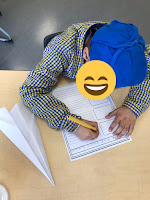
This week in Literacy we have been focussing on Sequential Writing or How To writing. We learned about what Sequence writing is and where we see it in our every day life (ex: recipes to make chocolate chip cookies), we then wrote our own "How To" instructions for brushing your teeth.
Students were then challenged to make their own "how to writing" on making paper airplanes. As a class we watched a video on making airplanes and made them together talking about each step. Students were then given a checklist and a graphic organizer and set out on writing their own 4 step set of instructions to help others learn how to make paper airplanes. 


Why Teach Sequencing?
Sequence writing is one of the most important literacy skills we can teach our students. By learning to write in sequence students are working on expressing their ideas clearly and proficiently. It will help them to develop their thought process which will help them as they continue to grow as learners. Sequencing will also help students in their reading as they will be able to clearly identify and write about each part of the story. 
  • Sequencing will also help students in their reading as they will be able to clearly identify and write about each part of the story. 
  • Students will begin to understand the structure of what they are reading, how it was put together and how they can do that in their own writing.
  • Understand how texts are kept cohesive through the use of linking devices such as transition phrases
  • Organize information and ideas in their own writing.
  • Develop problem-solving skills that are important in other curriculum areas too.
For our students, being able to identify the sequence of events in a piece of writing is essential for them to gain a clear understanding of what they are reading. An important reading comprehension strategy, sequencing allows students to make sense of how events unfold in their reading. This helps them to develop a logical flow in their own writing that readers can follow easily.
Sequence writing and sequential order are important in other curricular areas as well. For example, when writing about a Science experiment it is important to write instructions in an important order to ensure success. This form of writing is also important in Social Studies to ensure Historical Events are in the correct order, from timelines of students lives to important events happening in our City/Country/World. Finally this writing is an important part of problem solving in Math.

Monday, February 18, 2019

Why Read?


One of the major focuses of our year is reading. Students are taught a variety of strategies to help them decode new words as they progress in their reading journey. When you are at home reading with your child encourage them to call upon these strategies.


Reading at home with your child is one of the most important things that you can do to help them in their education. Even before they can read books themselves children learn to love the sound of language through printed words and being read to. By listening to someone read to them children are able to use their imagination and expand their understanding. This also helps them to develop their listening skills which is so crucial. Even after your child learns to read and becomes more independent it is still important to set time a side every day to read together. At this time if we choose books that are of interest to our children but above their reading level you challenge their understanding and can often motivate them to work on improving and growing. Aside from just reading together we often encourage parents to talk to their child about the book that they read. Making connections to the books we have read and just talking about stories can often inspire children love of reading as they see themselves in the stories. When a child develops a love of reading this can transfer over into all areas of their learning. They may progress from reading stories to reading books that teach them about animals, facts about the world, or even the world of coding! Reading books with our children is the stepping stone to creating passionate, life long learners.


In the classroom we set aside time each day to work with students in Guided Reading Groups. These groups allow us to read out loud with a group of students everyday. We are able to make predictions about the text, read the book, make connections and do follow up activities. This is one way that can strengthen our relationship with students while strengthening their reading skills. We work with the same book throughout the week which allows the students to work on their fluency and comprehension while reading books that relate to their interests. By working in smaller groups students are often more excited to share their connections to the text and gain confidence in what they are reading. Ask your child what book they are reading during Guided Reading time! 


Sunday, February 10, 2019

Using our Senses as Scientist


This week we became Scientists and Inventors after a local company reached out and asked for our help in designing a new sound proof box!

Dear Ron Southern Grade One,

WE NEED YOUR HELP!!!! 

Sound control is a big issue for science and a big business in society. Making movies takes extraordinary sound control. Unwanted noise can ruin an important scene. Traffic noise on highways makes people living in the area angry. Engineers and airport staff are always trying to reduce noise from airplane engines. People in some apartment buildings can hear casual conversations in other apartments that make peace and quiet seem impossible. Sometimes people have secrets that they want to keep from others. They are faced with how to talk so only specific individuals hear the conversation. And, while many are engaged in trying to eliminate unwanted sounds, some spies are busy trying to hear those seemingly hidden sounds.

Getting rid of unwanted sounds is the primary business of the "Silence Is Golden" sound proof company. We are looking for engineers to invent new ways to eliminate unwanted sounds. We want you to invent a box that can "hide" the sounds of a cell phone or an alarm clock. The box that wins this competition will be the one that weighs the least and contains sound so that it cannot be heard from 6 meters feet away.

We can’t wait to see what you come up with.

From,
The Sound Proof Guys


Students made predictions about how the boxes would work by using existing knowledge about their hearing and sound. In their groups of 4 they quickly got to work designing their plans. Once they sketched out their box and decided on materials it was time to get work inventing new sound proof technology! 


Students spent two days designing, testing and refining their boxes. The next step will be for students finish writing about the Scientific process by explaining how they made their boxes, why the work and what were some things they observed through the inventing process. 


By using real world scenarios and allowing students to solve real world problems the ideas that students are learning often becomes more meaningful and can spark excitement in the learning process. Research shows an increased value of authenticity when students are engaged in teaching strategies that use real-world problems. This teaching strategy also encourages students to become more aware of the choices they make in society.  By working on this scenario our Grade 1's learned why we need to have sound proofing in our lives, what would happen if we were always around loud noises and why we should take care of all our senses. 


Friday, February 1, 2019

Writing on Different Surfaces

This week we have been exploring with using a multitude of vertical surfaces and erasable surfaces in the classroom. During both Literacy and Math times students are using the SMART board, whiteboards, easels, chart paper, whiteboard tables, clipboards, and windows to practice their spelling, write sentences and create/solve Math equations.


There are so many benefits that students gain from using vertical surfaces that they don't get when working just at a desk with pencil and paper.

1) Shoulder and Elbow Stability: By writing on larger surfaces students are creating larger movements  which helps to strengthen their joints and muscles.
2) Midline Crossing: When writing on a large surface students cross the midline of their body with their dominant hand. This helps to increase strong hand dominate.
3) Pencil Grasp: Because students wrists are extended as they write on a vertical surface they work on bettering their stabilization creating a better pencil grip.
4) Hand/Eye Coordination: Students are more engaged and have more area to look at which helps to keep them focused and encourage hand/eye coordination.
5) Sensory: For students that have a hard time sitting while they work this gives them an opportunity to focus less on their wiggles on more on their work!
6) Core Strength: We have been working on increasing our core strength through stretching, work out of the day in gym, sitting properly and not using our hands when we get up. By having students stand or even kneel as they work there is less chance of slumping over which betters our posture and our core strength.
7) Collaboration: As students are working on larger surfaces they are able to work side by side with one or two other students. They challenge each other, they work together at solving problems, help each other with spelling words and they create masterpiece's together. Who doesn't love working and collaborating with friends!

We have watched students creativity grow this week with the collaboration and vertical writing and we can't wait to start using these surfaces in our Science and Social Studies!


Saturday, January 26, 2019

Learning at Home


Throughout the year we will be updating this page with a variety of resources that we use in class and that you can do at home with your student. Login information for Raz-Kids was sent home earlier this year with your child. If you are unsure of your student's password please email their teacher. 

Literacy

https://www.raz-kids.com


Math

https://kahoot.com


Spelling with Students


We have begun weekly spelling in Grade 1. Students receive their words each Monday and are given time each day during Literacy Centers to practice these words in a number of fun ways! On Fridays we get together in small groups and show what we know. Students will bring home their spelling show what you know each Friday and they can continue practicing these words with you at home.

There is a lot of research that shows practicing spelling words both in the classroom and at home can help students both in their writing and their reading!


We will post the words each Monday on the blog and printed lists will be sent home in SMILE folders!  

Wednesday, January 23, 2019

Looking through the Lens of Literacy


Over the last few weeks we have been focussing on expanding our literacy knowledge. Students are learning how to use books to find Math, Science, and Social Connections. We are learning that books can shape the way we think about topics and the way we see the world around us. 

For example, in Social studies we began to learn about what a time line is by reading "The Oak Tree." We learned that trees have rings on them for each year they have been growing. We then created our own timelines of important events that have happened in our lives. We are going to continue exploring timelines of both our lives and Calgary over the next several weeks. Ask me what some important milestones are in my life that I put on my timeline. 


We are also learning to look at books through a Mathematician lens. We have read multiple books such as "One is a Snail, Ten is a Crab" and "The Mitten." We recognized that if we add together the legs of animals we can create our own math problems. After learning about different animals and their attributes we created our own story books. Ask me some other ways that we can add animals together. We are so excited to continue using Literacy in our Math lessons! 


We encourage you when reading with your students to ask them questions about what they are reading. Find out where they see Math in the book or how can we look at this book as a Scientist. 

Trailblazing through Term One


We have been working really hard this semester. Here is a snap shot of everything that we have been busy doing. 


Wednesday, January 16, 2019

Exploring Winter


We have been exploring Winter over the last two weeks. Using our 5 senses we talked about what we see, smell, touch and hear in the winter months. Even though we don't have a lot of snow right now we know that in the winter we see snow and if we touch it the snow is really cold on our hands! Ask me how I use my other senses to find signs of winter.
On our Community Walk last week we noticed so many signs of Winter. We looked at Pine Trees and even noticed that some of the needles on the trees were turning blue! Ask me why? We learned a new skill called "Zoom Out, Zoom In" to help us sketch some signs of winter that we saw.


We also began talking about what happens to animals in the winter. Why don't we see insects, bears or geese in the winter? Where do they go? Students will continue to explore what happens to some of their favourite animals each year. We loved reading this book and it helped us to start our exploration of animals in the winter.

There are so many great things about winter and we can't wait to keep investigating seasonal changes